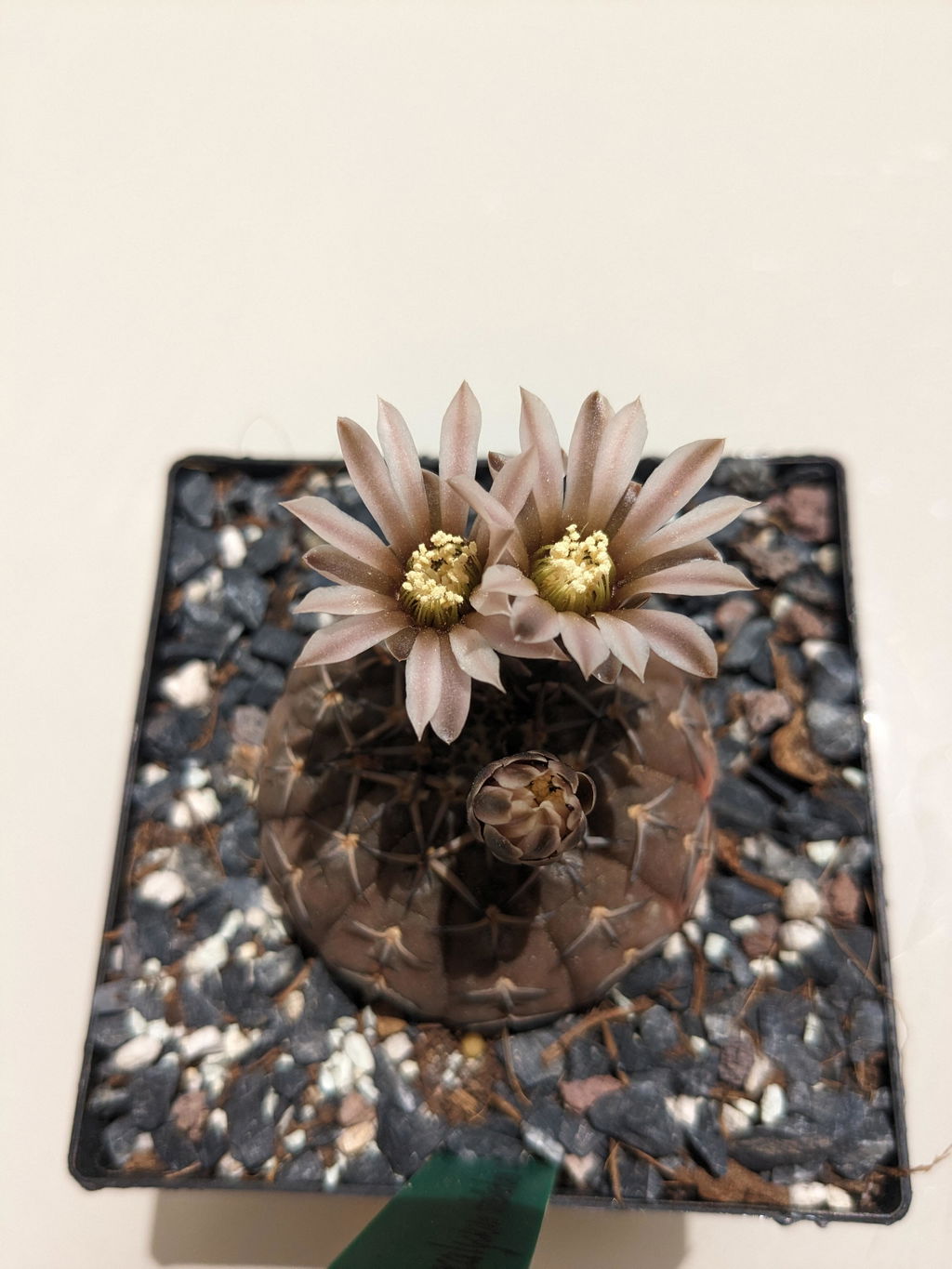
Gymnocalycium quehlianum | Sierras Sphere. Hump cactus
€10,60 €8,48
- Devoluciones a 30 días sin complicaciones
- Envío gratis a península en pedidos desde 79,99 €
- Entrega garantizada: si llega dañada, te la reponemos
Descripción
🌱 Morphology
A slow-growing cactus, generally solitary, with a globose-depressed body that is partially buried. Its grayish-green epidermis may take on brownish, purplish, or reddish tones in strong light. It reaches approximately 4–6 cm in height and 10–15 cm in diameter. It has around 11–14 low ribs, divided into rounded tubercles with a characteristic downward-projecting hump or “chin”. The initially woolly areoles bear 5–7 fine radial spines, which are short, appressed, and generally curved, with white, brownish, or reddish tones; it has no central spines. It develops a robust napiform root.
🌍 Distribution, habitat, and family
Endemic to the Sierras de Córdoba, Argentina, where it ranges from the Sierras Chicas to the Sierras del Norte, at approximately 500–1,200 m, although populations occur up to around 1,500 m. It grows in mountainous environments, on sandy, clayey, or stony soils, among grasses, shrubs, and small trees, as well as on rocky outcrops. It belongs to the family Cactaceae, subfamily Cactoideae, subgenus Trichomosemineum.
❄️ Temperature · USDA Zone 8b
It tolerates minimum temperatures down to −8 ºC when kept dry and when the plants are well acclimated. In cultivation, it is especially hardy when kept completely dry during cold spells.
☀️ Light
It needs plenty of light to maintain a compact epidermis and its characteristic spines. Direct sun or very bright light is recommended, with gradual acclimation. During active growth, a PAR DLI of 15–25 mol·m⁻²·day⁻¹ is suitable; in very hot summer weather, it may benefit from some protection during the middle of the day.
💧 Growth cycle and watering
Winter dormancy. Keep it practically dry throughout winter. As temperatures rise, gradually resume watering, preferably deeply and infrequently, allowing the substrate to dry out completely between waterings. In its habitat, rainfall is concentrated in the warmer months, so it tolerates dry cold better than a combination of low temperatures and moisture.
🌸 Flowering
The flowers appear near the apex and are white, up to around 6 cm across, with a reddish throat. In populations studied in Córdoba, flowering begins relatively early in the season and may continue for much of it: an early peak has been observed, followed by continued flowering around mid-season, with an average duration of about 36 days. It is therefore more accurate to describe it as prolonged flowering with successive blooms than as reblooming in clearly separated flushes.
No reliable, broadly applicable age for first flowering in cultivation has been established.
🌿 Nutrition
During active growth, a fertilizer high in assimilable calcium and low in nitrogen, such as Desert CHOICE® Cacti, is recommended. Apply once a month when watering. Before flowering, it can be supplemented with Desert CHOICE® Bloom.
This is a unique xerophytic plant grown in Madrid in a technological square pot, with substrate activated using mycorrhizal fungi and biofungicides.
9 × 9 cm pot
* As this is an online purchase, the appearance of the plant sent may differ slightly from the product image. The photo description specifies the plant’s measurements, but these may also vary slightly because it is a living thing! Every plant at Desert CITY has unique characteristics.
30-day money-back guarantee
Shop with complete peace of mind. If you are not satisfied, you have 30 days to return your order, no questions asked.
Expert advice with every purchase
Our team provides you with personalized advice on caring for your plants and growing media.
-
Secure and protected payment guaranteed.